


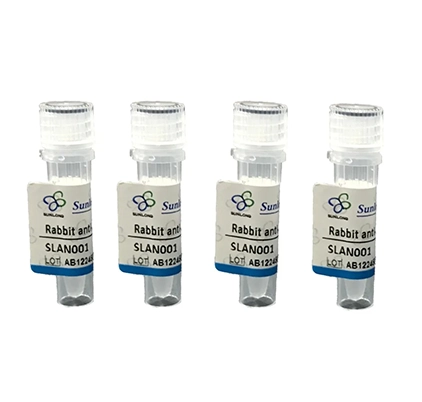
Details
| Product Name | GCK |
| Immunogen Species | Mouse |
| Clonality | Monoclonal |
| Clone NO. | G12H9 |
| React Species | Human,Mouse,Rat |
| Applications | WB=1:500-2000,IHC-P=1:100-500,IHC-F=1:100-500,ICC/IF=1:50-200,IF=1:100-500(Paraffin sections need antigen repair) not yet tested in other applications. optimal dilutions/concentrations should be determined by the end user. |
| Cellular localization | The nucleus The cell membrane |
| Form | Liquid |
| Concentration | 1mg/ml |
| Lsotype | IgG1/Kappa |
| Purification | Affinity purified by Protein G |
| Buffer Solution | 1M TBS(pH7.4) with 1% BSA, 3% Proclin300 and 50% Glycerol. |
| Storage | Shipped at 4℃. Store at -20 °C for one year. Avoid repeated freeze/thaw cycles. |
| Attention | This product as supplied is intended for research use only, not for use in human, therapeutic or diagnostic applications. |
| PubMed | PubMed |
| Product Detail | Catalyzes the phosphorylation of hexoses (such as D-glucose, D-fructose, and D-mannose) to hexose 6-phosphates (D-glucose 6-phosphate, D-fructose 6-phosphate, and D-mannose 6-phosphate, respectively). Compared with other hexokinases, hexokinase has a lower affinity for D-glucose and is only effective when glucose is abundant. It is mainly expressed in pancreatic β-cells and the liver, where it constitutes the rate-limiting step of glucose metabolism in these tissues. Since insulin secretion is parallel to glucose metabolism, and the low glucose affinity of GCK ensures that it can change its enzymatic activity within the physiological range of glucose concentrations, GCK acts as a glucose sensor in pancreatic β-cells. In the pancreas, it plays an important role in regulating insulin secretion. In the liver, it helps promote the absorption and conversion of glucose and serves as an insulin-sensitive determinant for hepatic glucose utilization. D-glucose 6-phosphate is required for glycogen synthesis. It mediates the initial step of glycolysis by catalyzing the phosphorylation of D-glucose to D-glucose 6-phosphate. |
Partial purchase records (0)
Leave a message
Call us
+86 0571 56623320
Address
Room 1-315, Kongle Changqing Building, No. 160 Guangye Road,Gongshu District, Hangzhou City, Zhejiang Province, China
About Us Contact Us Privacy Policy Shipping Policy Payment Policy Quality Guarantee Return & Refund policy Download Product list Distributors


 +86 0571 56623320
 [email protected]
 +86 18668110335

Scan Wechat Qrcode





 Manual