


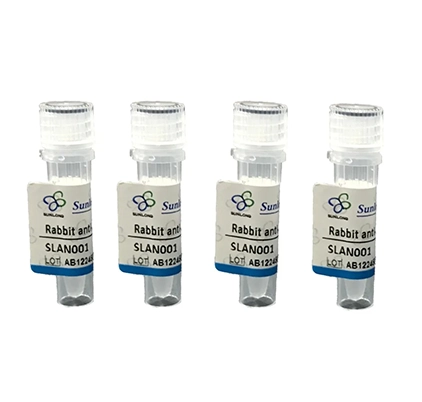
Details
| Product Name | RPL5 |
| Chinese Name | 核糖体蛋白L5抗体 |
| Immunogen Species | |
| Clonality | Polyclonal |
| React Species | Human,Mouse,Rat(predicted:Dog,Chicken,Cow,Horse,Rabbit,Sheep,Pig) |
| Applications |
WB=1:500-1:2000, IHC-P=1:100-500, IHC-F=1:100-500, IF=1:100-500 optimal dilutions/concentrations should be determined by the end user. |
| Cellular localization | The nucleus cytoplasmic |
| Form | Lyophilized or Liquid |
| Concentration | 1mg/ml |
| immunogen | KLH conjugated synthetic peptide derived from human RPL5 |
| Lsotype | IgG |
| Purification | affinity purified by Protein A |
| Storage | Shipped at 4℃. Store at -20 °C for one year. Avoid repeated freeze/thaw cycles. |
| Attention | This product as supplied is intended for research use only, not for use in human, therapeutic or diagnostic applications. |
| PubMed | PubMed |
| Product Detail |
Ribosomes, the organelles that catalyze protein synthesis, consist of a small 40S subunit and a large 60S subunit. Together these subunits are composed of 4 RNA species and approximately 80 structurally distinct proteins. This gene encodes a ribosomal protein that is a component of the 60S subunit. The protein belongs to the L18P family of ribosomal proteins. It is located in the cytoplasm. The protein binds 5S rRNA to form a stable complex called the 5S ribonucleoprotein particle (RNP), which is necessary for the transport of nonribosome-associated cytoplasmic 5S rRNA to the nucleolus for assembly into ribosomes. The protein interacts specifically with the beta subunit of casein kinase II. Variable expression of this gene in colorectal cancers compared to adjacent normal tissues has been observed, although no correlation between the level of expression and the severity of the disease has been found. This gene is co-transcribed with the small nucleolar RNA gene U21, which is located in its fifth intron. As is typical for genes encoding ribosomal proteins, there are multiple processed pseudogenes of this gene dispersed through the genome. Function: Required for rRNA maturation and formation of the 60S ribosomal subunits. This protein binds 5S RNA. Subcellular Location: Cytoplasm. Nucleus DISEASE: Defects in RPL5 are the cause of Diamond-Blackfan anemia type 6 (DBA6) . DBA6 is a form of Diamond-Blackfan anemia, a congenital non-regenerative hypoplastic anemia that usually presents early in infancy. Diamond-Blackfan anemia is characterized by a moderate to severe macrocytic anemia, erythroblastopenia, and an increased risk of malignancy. 30 to 40% of Diamond-Blackfan anemia patients present with short stature and congenital anomalies, the most frequent being craniofacial (Pierre-Robin syndrome and cleft palate), thumb and urogenital anomalies. Similarity: Belongs to the ribosomal protein L18P family. SWISS: P46777 Gene ID: 6125 Database links: Entrez Gene: 6125 Human Entrez Gene: 100503670 Mouse Omim: 603634 Human SwissProt: P46777 Human SwissProt: P47962 Mouse Unigene: 532359 Human Unigene: 277897 Mouse Unigene: 426204 Mouse Unigene: 92980 Rat |
| Product Picture |

Sample:
Lane 1: Human MOLT4 cell lysates Lane 2: Human U251 cell lysates Lane 3: Human U-2 OS cell lysates Primary: Anti-RPL5 (SL25696R) at 1/1000 dilution Secondary: IRDye800CW Goat Anti-Rabbit IgG at 1/20000 dilution Predicted band size: kDa Observed band size: 35 kDa 
Paraformaldehyde-fixed, paraffin embedded (mouse pancreas); Antigen retrieval by boiling in sodium citrate buffer (pH6.0) for 15min; Block endogenous peroxidase by 3% hydrogen peroxide for 20 minutes; Blocking buffer (normal goat serum) at 37°C for 30min; Incubation with (RPL5 ) Polyclonal Antibody, Unconjugated (SL25696R) at 1:200 overnight at 4°C, followed by operating according to SP Kit(Rabbit) (sp-0023) instructionsand DAB staining.

Paraformaldehyde-fixed, paraffin embedded (human brain); Antigen retrieval by boiling in sodium citrate buffer (pH6.0) for 15min; Block endogenous peroxidase by 3% hydrogen peroxide for 20 minutes; Blocking buffer (normal goat serum) at 37°C for 30min; Incubation with (RPL5 ) Polyclonal Antibody, Unconjugated (SL25696R) at 1:200 overnight at 4°C, followed by operating according to SP Kit(Rabbit) (sp-0023) instructionsand DAB staining.

Paraformaldehyde-fixed, paraffin embedded (human colon ); Antigen retrieval by boiling in sodium citrate buffer (pH6.0) for 15min; Block endogenous peroxidase by 3% hydrogen peroxide for 20 minutes; Blocking buffer (normal goat serum) at 37°C for 30min; Incubation with (RPL5 ) Polyclonal Antibody, Unconjugated (SL25696R) at 1:200 overnight at 4°C, followed by operating according to SP Kit(Rabbit) (sp-0023) instructionsand DAB staining.

Paraformaldehyde-fixed, paraffin embedded (human colon carcinoma); Antigen retrieval by boiling in sodium citrate buffer (pH6.0) for 15min; Block endogenous peroxidase by 3% hydrogen peroxide for 20 minutes; Blocking buffer (normal goat serum) at 37°C for 30min; Incubation with (RPL5 ) Polyclonal Antibody, Unconjugated (SL25696R) at 1:200 overnight at 4°C, followed by operating according to SP Kit(Rabbit) (sp-0023) instructionsand DAB staining.

Paraformaldehyde-fixed, paraffin embedded (rat pancreas); Antigen retrieval by boiling in sodium citrate buffer (pH6.0) for 15min; Block endogenous peroxidase by 3% hydrogen peroxide for 20 minutes; Blocking buffer (normal goat serum) at 37°C for 30min; Incubation with (RPL5 ) Polyclonal Antibody, Unconjugated (SL25696R) at 1:200 overnight at 4°C, followed by operating according to SP Kit(Rabbit) (sp-0023) instructionsand DAB staining.
|
Partial purchase records (0)
Leave a message
Call us
+86 0571 56623320
Address
Room 1-315, Kongle Changqing Building, No. 160 Guangye Road,Gongshu District, Hangzhou City, Zhejiang Province, China
About Us Contact Us Privacy Policy Shipping Policy Payment Policy Quality Guarantee Return & Refund policy Download Product list Distributors


 +86 0571 56623320
 [email protected]
 +86 18668110335

Scan Wechat Qrcode





 Manual