


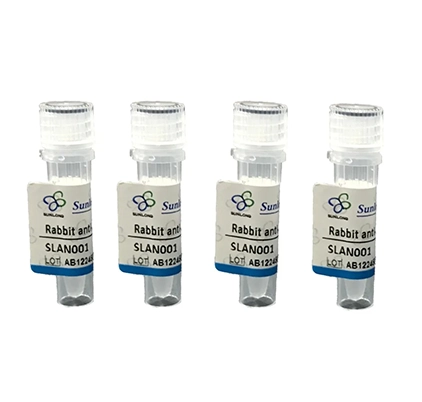
Details
| Product Name | UCHL1+3 |
| Chinese Name | Ubiquitin硫酯酶L1+3抗体 |
| Immunogen Species | |
| Clonality | Polyclonal |
| React Species | Human,Mouse(predicted:Rat,Pig,Dog,Cow,Horse,Rabbit,Sheep) |
| Applications |
IHC-P=1:100-500, IHC-F=1:100-500, IF=1:100-500, ICC/IF=1:50-1:200 optimal dilutions/concentrations should be determined by the end user. |
| Cellular localization | cytoplasmic The cell membrane |
| Form | Lyophilized or Liquid |
| Concentration | 1mg/ml |
| immunogen | KLH conjugated synthetic peptide derived from human UCHL1+3 |
| Lsotype | IgG |
| Purification | affinity purified by Protein A |
| Storage | Shipped at 4℃. Store at -20 °C for one year. Avoid repeated freeze/thaw cycles. |
| Attention | This product as supplied is intended for research use only, not for use in human, therapeutic or diagnostic applications. |
| PubMed | PubMed |
| Product Detail |
catalyzes the hydrolysis of ubiquitin carboxy-terminal thiolesters to form ubiquitin and a thiol; may play a role in neuropathic pain [RGD]. Found in neuronal cell bodies and processes throughout the neocortex (at protein level). Expressed in neurons and cells of the diffuse neuroendocrine system and their tumors. Weakly expressed in ovary. Down-regulated in brains from Parkinson disease and Alzheimer disease patients. Function: Ubiquitin-protein hydrolase involved both in the processing of ubiquitin precursors and of ubiquitinated proteins. This enzyme is a thiol protease that recognizes and hydrolyzes a peptide bond at the C-terminal glycine of ubiquitin. Also binds to free monoubiquitin and may prevent its degradation in lysosomes. The homodimer may have ATP-independent ubiquitin ligase activity. Subunit: Monomer. Homodimer. Interacts with SNCA (By similarity). Interacts with COPS5. Subcellular Location: Cytoplasm. Endoplasmic reticulum membrane. About 30% of total UCHL1 is associated with membranes in brain. Tissue Specificity: Found in neuronal cell bodies and processes throughout the neocortex (at protein level). Expressed in neurons and cells of the diffuse neuroendocrine system and their tumors. Weakly expressed in ovary. Down-regulated in brains from Parkinson disease and Alzheimer disease patients. Post-translational modifications: O-glycosylated. DISEASE: Defects in UCHL1 are the cause of Parkinson disease type 5 (PARK5) [MIM:613643]; also known as Parkinson disease autosomal dominant 5. PARK5 is a complex neurodegenerative disorder with manifestations ranging from typical Parkinson disease to dementia with Lewy bodies. Clinical features include parkinsonian symptoms (resting tremor, rigidity, postural instability and bradykinesia), dementia, diffuse Lewy body pathology, autonomic dysfunction, hallucinations and paranoia. Similarity: Belongs to the peptidase C12 family. Database links: Entrez Gene: 7345 Human Entrez Gene: 22223 Mouse SwissProt: P09936 Human SwissProt: Q9R0P9 Mouse 该抗原是一种神经特异性蛋白,广泛分布于中枢与外周神经系统的神经元和神经纤维、神经内分泌细胞、肾小管段、睾丸精原细胞、Leydig细胞、卵细胞以及妊娠与非妊娠黄体内的某些细胞。用于标记神经元,对研究几种人慢性神经变性性疾病中广泛存在的细胞包涵体特征较有意义。 |
| Product Picture |

Paraformaldehyde-fixed, paraffin embedded (mouse kidney); Antigen retrieval by boiling in sodium citrate buffer (pH6.0) for 15min; Block endogenous peroxidase by 3% hydrogen peroxide for 20 minutes; Blocking buffer (normal goat serum) at 37°C for 30min; Incubation with (UCHL1+3 ) Polyclonal Antibody, Unconjugated (SL25699R) at 1:200 overnight at 4°C, followed by operating according to SP Kit(Rabbit) (sp-0023) instructionsand DAB staining.

Paraformaldehyde-fixed, paraffin embedded (human kidney); Antigen retrieval by boiling in sodium citrate buffer (pH6.0) for 15min; Block endogenous peroxidase by 3% hydrogen peroxide for 20 minutes; Blocking buffer (normal goat serum) at 37°C for 30min; Incubation with (UCHL1+3 ) Polyclonal Antibody, Unconjugated (SL25699R) at 1:200 overnight at 4°C, followed by operating according to SP Kit(Rabbit) (sp-0023) instructionsand DAB staining.
|
Partial purchase records (0)
Leave a message
Call us
+86 0571 56623320
Address
Room 1-315, Kongle Changqing Building, No. 160 Guangye Road,Gongshu District, Hangzhou City, Zhejiang Province, China
About Us Contact Us Privacy Policy Shipping Policy Payment Policy Quality Guarantee Return & Refund policy Download Product list Distributors


 +86 0571 56623320
 [email protected]
 +86 18668110335

Scan Wechat Qrcode





 Manual