


Details
Sunlong Medical™ E. coli Host Cell Protein (HCP) G3 Residual Detection ELISA Kit (DH5α, One-Step)
For research use only. Not for use in diagnostic procedures.
1. APPLICATION
For the quantitative determination of host cell protein (HCP) residues of E. coli (DH5α) in protein purification processes and final products. Applicable strains: cloning strains such as DH5α, Top10 and JM109 (alkaline lysis method). The kit is suitable for in-process and final-product samples and is intended for the monitoring of host cell protein clearance during downstream process development and quality control.
E. coli is widely used in two main areas: first, as an expression system to produce the target protein, and second, as a cloning strain to produce plasmid DNA (pDNA). Because plasmid extraction usually involves a strongly alkaline solution to achieve cell lysis and protein denaturation, most HCPs are already denatured and inactivated during this process and are largely removed in the early purification stages by centrifugation, column chromatography and other means. The residual HCPs in the final plasmid product therefore differ greatly from those present when E. coli is used as an expression system to produce the target protein.
2. PRINCIPLE
This kit is based on the solid-phase sandwich enzyme-linked immunosorbent assay (ELISA). A capture antibody is pre-coated onto the microplate to form the solid-phase antibody. During the assay, the antigen to be tested and a horseradish peroxidase (HRP)-labeled detection antibody are added simultaneously to the coated wells to form a capture antibody-antigen-detection antibody complex. After washing, unbound conjugates are removed, and the substrate TMB is added for color development. TMB is oxidized by HRP and turns blue, and then turns yellow in the presence of acid. The color intensity after oxidation is positively correlated with the total amount of the factor. The absorbance (OD value) is measured on a microplate reader at 450 nm, fitted against the concentration to construct a standard curve, and the sample concentration is calculated by substituting the sample OD value into the standard curve equation.
3. KIT SPECIFICATIONS
Sensitivity (LOD): 0.39 ng/mL
Limit of quantification (LOQ): 0.78 ng/mL
Assay range: 0.78 - 200 ng/mL (7-point standard curve, S1 = 200 ng/mL)
Sample volume: 50 μL per well
Assay type: solid-phase sandwich ELISA (one-step), read at 450 nm
Specificity: This assay recognizes E. coli host cell protein (HCP). The following proteins were assayed and exhibited no cross-reactivity or interference.
| Sample | Concentration |
| HEK293 HCP | Not Detectable |
| Pichia pastoris HCP | Not Detectable |
Recovery: sample-matrix dependent; a spike recovery test is recommended when a different buffer is used for the first time, in order to exclude matrix interference effects; in practice, mix the diluted standard S1 (200 ng/mL) with the sample matrix at a 1:1 volume ratio
4. MATERIALS PROVIDED
For items that differ between the two kit sizes, values are given as 48 Test / 96 Test.
| # | Component | Specification |
| 1 | Antibody-coated microplate (detachable) | 48 wells / 96 wells |
| 2 | Standard stock solution (500 μg/mL) | 30 μL / 50 μL |
| 3 | Detection Antibody stock (100×) | 100 μL / 150 μL |
| 4 | TMB Substrate | 10 mL |
| 5 | Stop Solution | 10 mL |
| 6 | Wash Buffer Concentrate (20×) | 10 mL |
| 7 | Diluent (10×) | 10 mL |
| 8 | Plate Cover Seals | - |
| 9 | Instructions | - |
5. ASSAY PROCEDURE SUMMARY
Step 1. Add 50 μL of each standard or sample and 100 μL of 1× Detection Antibody to the appropriate wells; seal the plate and incubate at room temperature with shaking for 2 hours.
Step 2. Wash the plate 5 times with 1× Wash Buffer.
Step 3. Add 100 μL of TMB Substrate Solution and incubate for about 15 minutes at room temperature in the dark.
Step 4. Add 50 μL of Stop Solution and read the OD value at 450 nm.
6. TYPICAL DATA
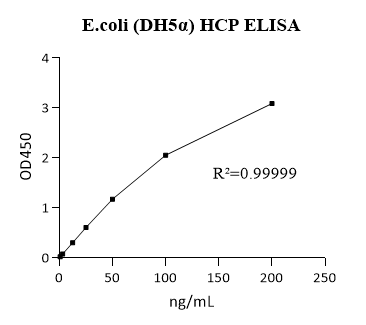
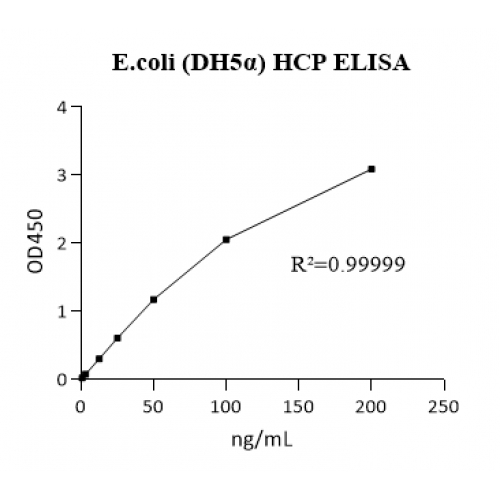
Appendix I: Example of a standard curve (schematic; for reference only).
Ordering & shipping
Partial purchase records (0)
Leave a message
Call us
+86 0571 56623320
Address
Room 1-315, Kongle Changqing Building, No. 160 Guangye Road,Gongshu District, Hangzhou City, Zhejiang Province, China
About Us Contact Us Privacy Policy Shipping Policy Payment Policy Quality Guarantee Return & Refund policy Download Product list Distributors


 +86 0571 56623320
 [email protected]
 +86 18668110335


Scan Wechat Qrcode





 Manual
