


Details
| Buffer Formulation | 20mM Tris, 150mM NaCl, pH8.0, containing 1mM EDTA, 1mM DTT, 0.01% SKL, 5% Trehalose and Proclin300. |
| Traits | Freeze-dried powder |
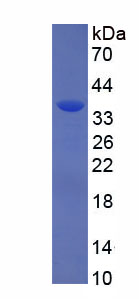
| Purity | > 95% |
| Isoelectric Point | 5.7 |
| Applications | Cell culture; Activity Assays. |
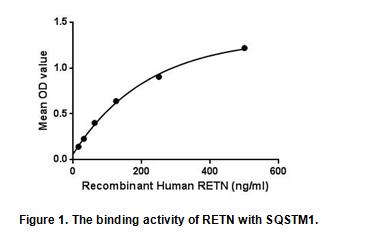
Resistin (RETN) also known as adipose tissue-specific secretory factor (ADSF) or C/EBP-epsilon-regulated myeloid-specific secreted cysteine-rich protein (XCP1) is a cysteine-rich adipose-derived peptide hormone. Resistin is an adipose-derived hormone (similar to a cytokine) whose physiologic role has been the subject of much controversy regarding its involvement with obesity and type II diabetes mellitus (T2DM). Resistin is involved in pathological processes leading to CVD including inflammation, endothelial dysfunction, thrombosis, angiogenesis and smooth muscle cell dysfunction. Besides, Sequestosome 1 (SQSTM1) has been identified as an interactor of RETN, thus a binding ELISA assay was conducted to detect the interaction of recombinant human RETN and recombinant human SQSTM1. Briefly, RETN were diluted serially in PBS, with 0.01% BSA (pH 7.4). Duplicate samples of 100uL were then transferred to SQSTM1-coated microtiter wells and incubated for 2h at 37℃. Wells were washed with PBST and incubated for 1h with anti-RETN pAb, then aspirated and washed 3 times. After incubation with HRP labelled secondary antibody, wells were aspirated and washed 3 times. With the addition of substrate solution, wells were incubated 15-25 minutes at 37℃. Finally, add 50µL stop solution to the wells and read at 450nm immediately. The binding activity of RETN and SQSTM1 was shown in Figure 1, and this effect was in a dose dependent manner.
USAGE
Reconstitute in 20mM Tris, 150mM NaCl (PH8.0) to a concentration of 0.1-1.0 mg/mL. Do not vortex.
STORAGE
Avoid repeated freeze/thaw cycles. Store at 2-8°C for one month. Aliquot and store at -80°C for 12 months.
STABILITY
The thermal stability is described by the loss rate. The loss rate was determined by accelerated thermal degradation test, that is, incubate the protein at 37°C for 48h, and no obvious degradation and precipitation were observed. The loss rate is less than 5% within the expiration date under appropriate storage condition.
Partial purchase records (0)
Leave a message
Call us
+86 0571 56623320
Address
Room 1-315, Kongle Changqing Building, No. 160 Guangye Road,Gongshu District, Hangzhou City, Zhejiang Province, China
About Us Contact Us Privacy Policy Shipping Policy Payment Policy Quality Guarantee Return & Refund policy Download Product list Distributors


 +86 0571 56623320
 [email protected]
 +86 18668110335

Scan Wechat Qrcode





 Manual