


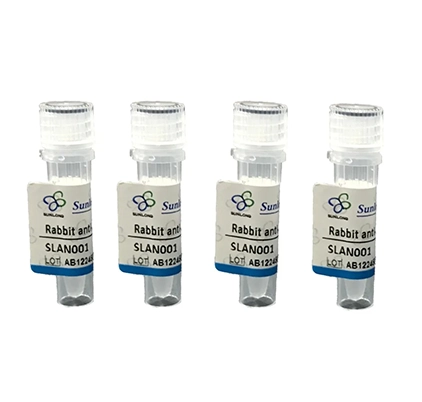
Details
| Product Name | Anti-PCDHB5/AF647 |
| Chinese Name | AF647标记的G protein-coupled receptor169抗体 |
| Alias | G protein coupled receptor 169; G protein coupled receptor MRGG; G-protein coupled receptor 169; GPR169; Mas related G protein coupled receptor member G; MAS related GPR member G; Mas-related G-protein coupled receptor member G; MRGG; MRGPRG; MRGRG_HUMAN; MRGRG_MOUSE. |
| Research Area | |
| Immunogen Species | Rabbit |
| Clonality | Polyclonal |
| React Species | (predicted:Human) |
| Applications | ICC/IF=1:50-200,IF=1:100-500
not yet tested in other applications. optimal dilutions/concentrations should be determined by the end user. |
| Molecular weight | 32kDa |
| Form | Lyophilized or Liquid |
| Concentration | 1mg/ml |
| immunogen | KLH conjugated synthetic peptide derived from mouse PCDHB5 |
| Lsotype | IgG |
| Purification | affinity purified by Protein A |
| Storage Buffer | 1M TBS(pH7.4) with 1% BSA, 3% Proclin300 and 50% Glycerol. |
| Storage | Store at -20 °C for one year. Avoid repeated freeze/thaw cycles. The lyophilized antibody is stable at room temperature for at least one month and for greater than a year when kept at -20°C. When reconstituted in sterile pH 7.4 1M PBS or diluent of antibody the antibody is stable for at least two weeks at 2-4 °C. |
| Product Detail |
background: MRGG is a 289 amino acid multi-pass membrane protein that functions as an orphan receptor. A member of the G-protein coupled receptor 1 family and Mas subfamily, MRGG is implicated in pain sensation and modulation by regulating nociceptor function. The gene encoding MRGG maps to human chromosome 11, which comprises approximately 4% of human genomic DNA and is considered a gene and disease association dense chromosome. The chromosome 11 encoded Atm gene is important for regulation of cell cycle arrest and apoptosis following double strand DNA breaks. Atm mutation leads to the disorder known as ataxia-telangiectasia. The blood disorders Sickle cell anemia and thalassemia are caused by HBB gene mutations, while Wilms' tumors, WAGR syndrome and Denys-Drash syndrome are associated with mutations of the WT1 gene. Jervell and Lange-Nielsen syndrome, Jacobsen syndrome, Niemann-Pick disease, hereditary angioedema and Smith-Lemli-Opitz syndrome are also associated with defects in chromosome 11-encoded genes. Function: Orphan receptor. May regulate nociceptor function and/or development, including the sensation or modulation of pain. Subcellular Location: Cell membrane. Similarity: Belongs to the G-protein coupled receptor 1 family. Mas subfamily. Database links: Entrez Gene: 386746 Mouse Important Note: This product as supplied is intended for research use only, not for use in human, therapeutic or diagnostic applications. |
Partial purchase records (6)
| Username | Quantity | bought time |
| Ge*** | 1 | 2024-07-26 |
| Fe*** | 2 | 2023-12-27 |
| Da*** | 2 | 2023-12-02 |
| Sa*** | 2 | 2023-11-12 |
| Le*** | 1 | 2023-10-26 |
Leave a message
Call us
+86 0571 56623320
Address
Room 1-315, Kongle Changqing Building, No. 160 Guangye Road,Gongshu District, Hangzhou City, Zhejiang Province, China
About Us Contact Us Privacy Policy Shipping Policy Payment Policy Quality Guarantee Return & Refund policy Download Product list Distributors


 +86 0571 56623320
 [email protected]
 +86 18668110335

Scan Wechat Qrcode





 Manual