


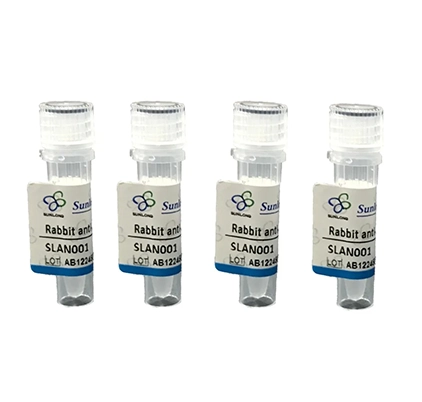
Details
| Product Name | Anti-FSH receptor/AF647 |
| Chinese Name | AF647标记的促卵泡刺激素受体抗体 |
| Alias | Follicle-stimulating hormone receptor precursor; Follicle stimulating hormone receptor; Follicle stimulating hormone receptor isoform 1; Follitropin receptor; FSHRO; LGR1; ODG1; Follicle-stimulating hormone receptor; FSH-R; FSH R; Fshr; FSHR_HUMAN; MGC141667; MGC141668; ovarian dysgenesis 1. |
| Research Area | Cell biology Developmental biology Signal transduction |
| Immunogen Species | Rabbit |
| Clonality | Polyclonal |
| React Species | Human,Mouse,Rat(predicted:Dog,Pig,Cow,Horse,Sheep) |
| Applications | Flow-Cyt=1ug/Test,IF=1:100-500
not yet tested in other applications. optimal dilutions/concentrations should be determined by the end user. |
| Molecular weight | 78kDa |
| Form | Lyophilized or Liquid |
| Concentration | 1mg/ml |
| immunogen | KLH conjugated synthetic peptide derived from human FSH receptor |
| Lsotype | IgG |
| Purification | affinity purified by Protein A |
| Storage Buffer | 1M TBS(pH7.4) with 1% BSA, 3% Proclin300 and 50% Glycerol. |
| Storage | Store at -20 °C for one year. Avoid repeated freeze/thaw cycles. The lyophilized antibody is stable at room temperature for at least one month and for greater than a year when kept at -20°C. When reconstituted in sterile pH 7.4 1M PBS or diluent of antibody the antibody is stable for at least two weeks at 2-4 °C. |
| Product Detail |
background: The protein encoded by this gene belongs to family 1 of G-protein coupled receptors. It is the receptor for follicle stimulating hormone and functions in gonad development. Mutations in this gene cause ovarian dysgenesis type 1, and also ovarian hyperstimulation syndrome. Alternative splicing results in multiple transcript variants. [provided by RefSeq, Mar 2010] Function: Receptor for follicle-stimulating hormone. The activity of this receptor is mediated by G proteins which activate adenylate cyclase. Subunit: Interacts with ARRB2. Subcellular Location: Cell membrane; Multi-pass membrane protein. Tissue Specificity: Sertoli cells and ovarian granulosa cells. DISEASE: Defects in FSHR are a cause of ovarian dysgenesis type 1 (ODG1) [MIM:233300]; also known as premature ovarian failure or gonadal dysgenesis XX type or XX gonadal dysgenesis (XXGD) or hereditary hypergonadotropic ovarian failure or hypergonadotropic ovarian dysgenesis with normal karyotype. ODG1 is an autosomal recessive disease characterized by primary amenorrhea, variable development of secondary sex characteristics, and high serum levels of follicle-stimulating hormone (FSH) and luteinizing hormone (LH). Defects in FSHR are a cause of ovarian hyperstimulation syndrome (OHSS) [MIM:608115]. OHSS is a disorder which occurs either spontaneously or most often as an iatrogenic complication of ovarian stimulation treatments for in vitro fertilization. The clinical manifestations vary from abdominal distention and discomfort to potentially life-threatening, massive ovarian enlargement and capillary leak with fluid sequestration. Pathologic features of this syndrome include the presence of multiple serous and hemorrhagic follicular cysts lined by luteinized cells, a condition called hyperreactio luteinalis. Similarity: Belongs to the G-protein coupled receptor 1 family. FSH/LSH/TSH subfamily. Contains 9 LRR (leucine-rich) repeats. Contains 1 LRRNT domain. Database links: Entrez Gene: 2492 Human Entrez Gene: 14309 Mouse Entrez Gene: 443299 Sheep Omim: 136435 Human SwissProt: P23945 Human SwissProt: P35378 Mouse SwissProt: P35379 Sheep Unigene: 1428 Human Unigene: 57155 Mouse Unigene: 162843 Rat Important Note: This product as supplied is intended for research use only, not for use in human, therapeutic or diagnostic applications. FSHR属于G protein-coupled receptor超家族中的glycoprotein亚家族成员,Transmembrane protein。人类的FSHR是由695个氨基酸组成的一条肽链,主要分布于睾丸支持细胞和卵巢颗粒细胞 |
Partial purchase records (5)
| Username | Quantity | bought time |
| Al*** | 2 | 2024-07-07 |
| Be*** | 2 | 2024-04-07 |
| Sa*** | 1 | 2024-03-24 |
| Ra*** | 1 | 2024-01-20 |
| Mi*** | 2 | 2023-07-06 |
Leave a message
Call us
+86 0571 56623320
Address
Room 1-315, Kongle Changqing Building, No. 160 Guangye Road,Gongshu District, Hangzhou City, Zhejiang Province, China
About Us Contact Us Privacy Policy Shipping Policy Payment Policy Quality Guarantee Return & Refund policy Download Product list Distributors


 +86 0571 56623320
 [email protected]
 +86 18668110335

Scan Wechat Qrcode





 Manual