


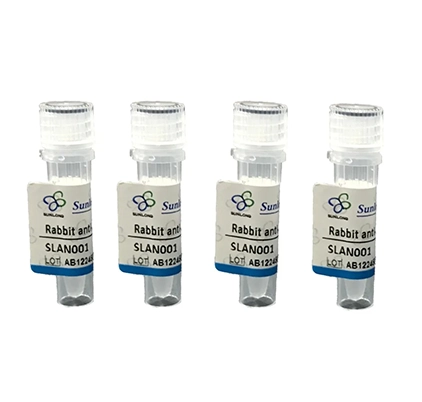
Details
| Product Name | Anti-BTD/AP |
| Chinese Name | 碱性磷酸酶(AP)标记的生物素酶抗体 |
| Alias | Biotinase; Biotinidase; Btd; Sp8; BTD_HUMAN; EC 3.5.1.12. |
| Research Area | Cell biology Neurobiology Signal transduction |
| Immunogen Species | Rabbit |
| Clonality | Polyclonal |
| React Species | Rat(predicted:Human,Mouse,Chicken,Dog,Cow,Horse,Rabbit,Sheep) |
| Applications | IHC-P=1:100-500,IHC-F=1:100-500
not yet tested in other applications. optimal dilutions/concentrations should be determined by the end user. |
| Molecular weight | 57kDa |
| Form | Lyophilized or Liquid |
| Concentration | 1mg/ml |
| immunogen | KLH conjugated synthetic peptide derived from human Biotinidase |
| Lsotype | IgG |
| Purification | affinity purified by Protein A |
| Storage Buffer | 1M TBS(pH7.4) with 1% BSA, 3% Proclin300 and 50% Glycerol. |
| Storage | Store at -20 °C for one year. Avoid repeated freeze/thaw cycles. The lyophilized antibody is stable at room temperature for at least one month and for greater than a year when kept at -20°C. When reconstituted in sterile pH 7.4 1M PBS or diluent of antibody the antibody is stable for at least two weeks at 2-4 °C. |
| Product Detail |
background: Biotin, also known as vitamin B7, is an essential water-soluble vitamin that is a cofactor in glucogenesis and in the metabolism of fatty acids and leucine. Biotinidase is a 523 amino acid enzyme that catalyzes the hydrolysis of biocytin to biotin and lysine. Secreted into extracellular space, biotinidase is expressed in liver, heart, placenta, brain, skeletal muscle, pancreas and kidney. Biotinidase contains one carbon-nitrogen hydrolase domain, which is involved in the reduction of organic nitrogen compounds and ammonia production. Defects in the gene encoding biotinidase are the cause of biotinidase deficiency, which is characterized by skin rash, ataxia, seizures, hearing loss, hypotonia and optic atrophy. These symptoms are due to the individual’s inability to reutilize biotin and can, therefore, typically be treated with the addition of free biotin. Function: Catalytic release of biotin from biocytin, the product of biotin-dependent carboxylases degradation. Subcellular Location: Secreted. DISEASE: Defects in BTD are the cause of biotinidase deficiency (BTD deficiency) [MIM:253260]; also called late-onset multiple carboxylase deficiency. BTD deficiency is a juvenile form of multiple carboxylase deficiency, an autosomal recessive disorder of biotin metabolism, characterized by ketoacidosis, hyperammonemia, excretion of abnormal organic acid metabolites, and dermatitis. BTD deficiency is characterized by seizures, hypotonia, skin rash, alopecia, ataxia, hearing loss, and optic atrophy. If untreated, symptoms usually become progressively worse, and coma and death may occur. Similarity: Belongs to the CN hydrolase family. BTD/VNN subfamily. Contains 1 CN hydrolase domain. Database links: Entrez Gene: 686 Human Omim: 609019 Human SwissProt: P43251 Human Unigene: 517830 Human Important Note: This product as supplied is intended for research use only, not for use in human, therapeutic or diagnostic applications. |
Partial purchase records (1)
| Username | Quantity | bought time |
| Th*** | 2 | 2024-03-20 |
Leave a message
Call us
+86 0571 56623320
Address
Room 1-315, Kongle Changqing Building, No. 160 Guangye Road,Gongshu District, Hangzhou City, Zhejiang Province, China
About Us Contact Us Privacy Policy Shipping Policy Payment Policy Quality Guarantee Return & Refund policy Download Product list Distributors


 +86 0571 56623320
 [email protected]
 +86 18668110335

Scan Wechat Qrcode





 Manual