


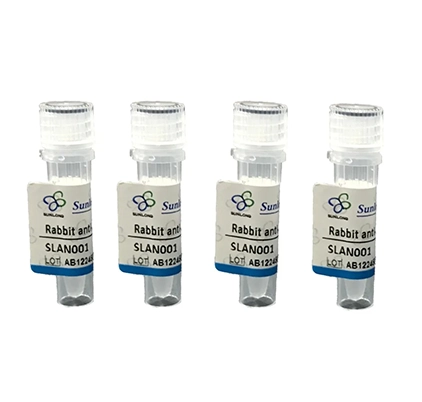
Details
| Product Name | AIF |
| Chinese Name | 调亡诱导因子抗体 |
| Alias | Apoptosis inducing factor; Harlequin; Hq; mAIF; MGC111425; MGC5706; PDCD 8; PDCD8; Programmed cell death 8; Programmed cell death 8 isoform 1; Programmed cell death 8 isoform 2; Programmed cell death 8 isoform 3; Programmed cell death protein 8 mitochondrial; Programmed cell death protein 8 mitochondrial precursor; Striatal apoptosis inducing factor; AIFM1_HUMAN; Apoptosis-inducing factor 1, mitochondrial. |
| Research Area | Tumour Cell biology Chromatin and nuclear signals Neurobiology Apoptosis Cyclin Mitochondrion |
| Immunogen Species | Mouse |
| Clonality | Polyclonal |
| React Species | Human, (predicted: Mouse, Rat, Chicken, Dog, Pig, Cow, Rabbit, Sheep, ) |
| Applications | IHC-P=1:100-500,IHC-F=1:100-500,IF=1:100-500,ELISA=1:5000-10000 (Paraffin sections need antigen repair)
not yet tested in other applications. optimal dilutions/concentrations should be determined by the end user. |
| Theoretical molecular weight | 56kDa |
| Cellular localization | The nucleus cytoplasmic Mitochondrion |
| Form | Liquid |
| Concentration | 1mg/ml |
| immunogen | KLH conjugated synthetic peptide derived from human AIF: 131-230/613 |
| Lsotype | IgG |
| Purification | affinity purified by Protein A |
| Buffer Solution | 1M TBS(pH7.4) with 1% BSA, 3% Proclin300 and 50% Glycerol. |
| Storage | Shipped at 4℃. Store at -20 °C for one year. Avoid repeated freeze/thaw cycles. |
| Attention | This product as supplied is intended for research use only, not for use in human, therapeutic or diagnostic applications. |
| PubMed | PubMed |
| Product Detail |
This gene encodes a flavoprotein essential for nuclear disassembly in apoptotic cells, and it is found in the mitochondrial intermembrane space in healthy cells. Induction of apoptosis results in the translocation of this protein to the nucleus where it affects chromosome condensation and fragmentation. In addition, this gene product induces mitochondria to release the apoptogenic proteins cytochrome c and caspase-9. Mutations in this gene cause combined oxidative phosphorylation deficiency 6, which results in a severe mitochondrial encephalomyopathy. Alternative splicing results in multiple transcript variants. A related pseudogene has been identified on chromosome 10. [provided by RefSeq, May 2010]. Function: Probable oxidoreductase that has a dual role in controlling cellular life and death; during apoptosis, it is translocated from the mitochondria to the nucleus to function as a proapoptotic factor in a caspase-independent pathway, while in normal mitochondria, it functions as an antiapoptotic factor via its oxidoreductase activity. The soluble form (AIFsol) found in the nucleus induces 'parthanatos' i.e. caspase-independent fragmentation of chromosomal DNA. Interacts with EIF3G,and thereby inhibits the EIF3 machinery and protein synthesis, and activates casapse-7 to amplify apoptosis. Plays a critical role in caspase-independent, pyknotic cell death in hydrogen peroxide-exposed cells. Binds to DNA in a sequence-independent manner. Subunit: Interacts with XIAP/BIRC4. Interacts (via N-terminus) with EIF3G (via C-terminus). Subcellular Location: Mitochondrion intermembrane space. Mitochondrion inner membrane. Cytoplasm. Nucleus. Cytoplasm, perinuclear region. Note=Proteolytic cleavage during or just after translocation into the mitochondrial intermembrane space (IMS) results in the formation of an inner-membrane-anchored mature form (AIFmit). During apoptosis, further proteolytic processing leads to a mature form, which is confined to the mitochondrial IMS in a soluble form (AIFsol). AIFsol is released to the cytoplasm in response to specific death signals, and translocated to the nucleus, where it induces nuclear apoptosis. Colocalizes with EIF3G in the nucleus and perinuclear region. Tissue Specificity: Isoform 5 is frequently down-regulated in human cancers. Post-translational modifications: Under normal conditions, a 54-residue N-terminal segment is first proteolytically removed during or just after translocation into the mitochondrial intermembrane space (IMS) by the mitochondrial processing peptidase (MPP) to form the inner-membrane-anchored mature form (AIFmit). During apoptosis, it is further proteolytically processed at amino-acid position 101 leading to the generation of the mature form, which is confined to the mitochondrial IMS in a soluble form (AIFsol). AIFsol is released to the cytoplasm in response to specific death signals, and translocated to the nucleus, where it induces nuclear apoptosis in a caspase-independent manner. Ubiquitination by XIAP/BIRC4 does not lead to proteasomal degradation. Ubiquitination at Lys-255 by XIAP/BIRC4 blocks its ability to bind DNA and induce chromatin degradation, thereby inhibiting its ability to induce cell death. DISEASE: Defects in AIFM1 are the cause of combined oxidative phosphorylation deficiency type 6 (COXPD6) [MIM:300816]. It is a mitochondrial disease resulting in a neurodegenerative disorder characterized by psychomotor delay, hypotonia, areflexia, muscle weakness and wasting. Similarity: Belongs to the FAD-dependent oxidoreductase family. SWISS: O95831 Gene ID: 9131 Database links: Entrez Gene: 9131 Human Entrez Gene: 26926 Mouse Omim: 300169 Human SwissProt: O95831 Human SwissProt: Q9Z0X1 Mouse Unigene: 424932 Human Unigene: 476033 Human Unigene: 240434 Mouse Unigene: 203165 Rat AIF是一种易位到The nucleus诱导凋亡的Mitochondrion蛋白, AIF可引起DNA破碎、染色质凝聚,还可诱导细胞色素C和Caspase-9从Mitochondrion中释放出来,AIF从Mitochondrion中的释放可被过度表达的Bcl-2(一种参与Mitochondrion渗透的蛋白质)所抑制。 |
Partial purchase records (5)
| Username | Quantity | bought time |
| He*** | 1 | 2025-12-21 |
| Le*** | 1 | 2025-12-08 |
| Di*** | 1 | 2025-11-29 |
| Ma*** | 1 | 2025-11-18 |
| Re*** | 1 | 2025-11-04 |
Leave a message
Call us
+86 0571 56623320
Address
Room 1-315, Kongle Changqing Building, No. 160 Guangye Road,Gongshu District, Hangzhou City, Zhejiang Province, China
About Us Contact Us Privacy Policy Shipping Policy Payment Policy Quality Guarantee Return & Refund policy Download Product list Distributors


 +86 0571 56623320
 [email protected]
 +86 18668110335

Scan Wechat Qrcode





 Manual