


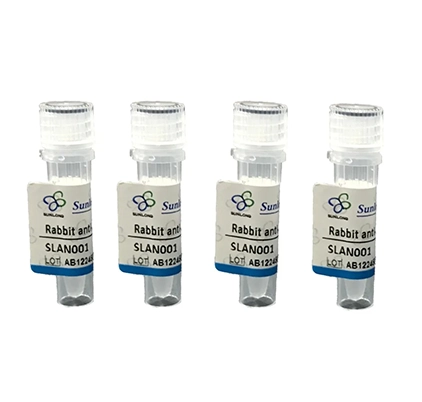
Details
| Product Name | KLK14 |
| Chinese Name | 激肽释放酶14抗体 |
| Alias | Kallikrein 14; kallikrein-related peptidase 14; hK14; Kallikrein-like protein 6; KLK-L6; KLKL6; GK14; MGC157618. |
| Research Area | Tumour Cell biology Signal transduction Kinases and Phosphatases |
| Immunogen Species | Rabbit |
| Clonality | Polyclonal |
| React Species | Rat(predicted:Human,Mouse,Dog,Cow,Horse) |
| Applications | WB=1:500-2000,IHC-P=1:100-500,IHC-F=1:100-500,IF=1:100-500 (Paraffin sections need antigen repair)
not yet tested in other applications. optimal dilutions/concentrations should be determined by the end user. |
| Theoretical molecular weight | 25/29kDa |
| Cellular localization | Extracellular matrix Secretory protein |
| Form | Liquid |
| Concentration | 1mg/ml |
| immunogen | KLH conjugated synthetic peptide derived from human KLK14: 201-267/267 |
| Lsotype | IgG |
| Purification | affinity purified by Protein A |
| Buffer Solution | 1M TBS(pH7.4) with 1% BSA, 3% Proclin300 and 50% Glycerol. |
| Storage | Shipped at 4℃. Store at -20 °C for one year. Avoid repeated freeze/thaw cycles. |
| Attention | This product as supplied is intended for research use only, not for use in human, therapeutic or diagnostic applications. |
| PubMed | PubMed |
| Product Detail |
The human tissue Kallikrein gene family encodes 15 serine proteases. All Kallikreins share structural similarities including cysteine residues, a catalytic triad of His, Asp and Ser residues, typically five coding exons, and varied intron phases. Kallikreins are predominantly secreted as inactive zymogens prior to activation by cleavage of an N-terminal peptide and all function extracellularly. Kallikreins can be activated autocatalytically, via other Kallikreins, or additional proteases. While structurally similar, Kallikrein family members have distinct functions and have key roles in many physiological and pathological processes. Many human tissue Kallikreins also show promise as cancer biomarkers, which may facilitate earlier detection and characterization of many forms of cancer. Kallikrein 14, also known as kallikrein-like6 (KLK-L6), is a trypsin-like serine proteinase. Kallikrein 14 was discovered by cloning the kallikrein locus on chromosome 19 and was found to be similar to the other kallikrein family genes. Kallikrein 14 is produced by a number of tissues, including the brain, spinal cord, esophagus, salivary gland, breast, prostate, uterus, lung, thymus and thyroid. Like many of the kallikreins, Kallikrein 14 is also found in biological fluids like serum, breast milk, amniotic fluid, seminal plasma and cerebrospinal fluid. Kallikrein 14 message has been reported to be decreased in some breast cancers and in ovarian cancers, similar to Kallikrein 10. Some cell lines express Kallikrein 14 in culture and like many of the kallikreins, the production is stimulated by hormones. Recombinant kallikrein 14 was profiled on peptide substrates and found to possess both trypsin-like and chymotrypsin-like activity. The ECM proteins lamanin and collagen-IV are thought to be substrates of Kallikrein 14. Endogenous inhibitors include kallistatin, protein-C inhibitor and alpha1-proteinase inhibitor, although Kallikrein 14 can be found complexed to a number of different proteinase inhibitors. Subunit: Interacts directly with BAK1, BID, BMF and BBC3 (By similarity). Interacts directly with BCL2L11/BIM. Interacts with BAX isoform Sigma. Subcellular Location: Secreted, extracellular space. Tissue Specificity: "Highly expressed in CNS, bone marrow and fetal liver. Similarity: Belongs to the Bcl-2 family. SWISS: Q9P0G3 Gene ID: 43847 Database links: Entrez Gene: 43847 Human Entrez Gene: 317653 Mouse Omim: 606135 Human SwissProt: Q9P0G3 Human SwissProt: Q8CGR5 Mouse Unigene: 283925 Human Unigene: 247377 Mouse KLK14目前认为在宫颈鳞癌和腺癌中都有表达,是很有意义的Maker。激肽释放酶KLK是激肽系统的主要限速酶,它是一组存在于多数组织和体液中的丝氨酸蛋白酶,是一种肽链内切酶。KLK又称血管舒缓素,包括15个家族成员。在不同的组织中广泛表达,具有蛋白水解酶的活性。它特异性的在碳末端切割底物肽,可裂解激肽原释放具有活性的激肽,由激肽发挥对Cardiovascular系统及肾脏功能的调节作用。 |
| Product Picture |

Sample:Cerebrum (Rat)Lysate at 40 ug
Primary: Anti-KLK14(SL1968R)at 1/300 dilution Secondary: IRDye800CW Goat Anti-RabbitIgG at 1/20000 dilution Predicted band size: 25'29kD Observed band size: 29kD 
Tissue/cell: rat brain tissue; 4% Paraformaldehyde-fixed and paraffin-embedded;
Antigen retrieval: citrate buffer ( 1M, pH 6.0 ), Boiling bathing for 15min; Block endogenous peroxidase by 3% Hydrogen peroxide for 30min; Blocking buffer (normal goat serum,C-0005) at 37℃ for 20 min; Incubation: Anti-KLK14 Polyclonal Antibody, Unconjugated(SL1968R) 1:200, overnight at 4°C, followed by conjugation to the secondary antibody(SP-0023) and DAB(C-0010) staining |
Partial purchase records (0)
Leave a message
Call us
+86 0571 56623320
Address
Room 1-315, Kongle Changqing Building, No. 160 Guangye Road,Gongshu District, Hangzhou City, Zhejiang Province, China
About Us Contact Us Privacy Policy Shipping Policy Payment Policy Quality Guarantee Return & Refund policy Download Product list Distributors


 +86 0571 56623320
 [email protected]
 +86 18668110335

Scan Wechat Qrcode





 Manual