


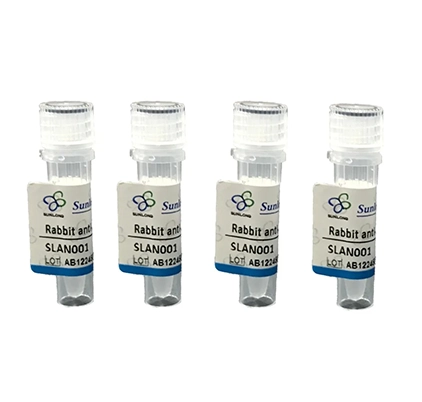
Details
| Product Name | Periostin |
| Chinese Name | 成骨细胞特异性因子2抗体 |
| Alias | OSF 2; OSF2; osteoblast specific factor 2 (fasciclin I-like); Osteoblast specific factor 2; Osteoblast specific factor; PDLPOSTN; Periodontal ligament specific periostin; Periostin isoform thy2; Periostin isoform thy4; Periostin isoform thy6; Periostin isoform thy8; Periostin osteoblast specific factor; PN; POSTN; POSTN_HUMAN. |
| literatures |
Specific References (4) | SL4994R has been referenced in 4 publications.
[IF=4.547] Zheng, Qingbo. et al. Construction of transcriptome atlas of white yak hair follicle during anagen and catagen using single-cell RNA sequencing. BMC GENOMICS. 2022 Dec;23(1):1-14 IHC ; Yak.
[IF=4.225] Xiaoli Du. et al. Tengdan Capsule Prevents Hypertensive Kidney Damage in SHR by Inhibiting Periostin-Mediated Renal Fibrosis. Front Pharmacol. 2021; 12: 638298 IHC ; Rat.
[IF=2.847] Gan Caiqin. et al. SPOCK1 and POSTN are valuable prognostic biomarkers and correlate with tumor immune infiltrates in colorectal cancer. BMC GASTROENTEROL. 2023 Dec;23(1):1-17 IHC,IF ; Human.
[IF=0.617] Jiang B et al. Dynamic changes of periostin and collagen I in the sclera during progressive myopia in guinea pigs. Arq Bras Oftalmol. 2020 Jun;83(3):190-195. IHC ; Guinea pig.
|
| Research Area | Tumour Cardiovascular Cell biology immunology Signal transduction transcriptional regulatory factor Cell adhesion molecule vascular endothelial cell TumourCell biologyMaker |
| Immunogen Species | Rabbit |
| Clonality | Polyclonal |
| React Species | (predicted: Human, Mouse, Rat, Pig, Cow, Horse, Rabbit, ) |
| Applications | WB=1:500-2000,IHC-P=1:100-500,IHC-F=1:100-500,IF=1:100-500,ELISA=1:5000-10000 (Paraffin sections need antigen repair)
not yet tested in other applications. optimal dilutions/concentrations should be determined by the end user. |
| Theoretical molecular weight | 100kDa |
| Cellular localization | Extracellular matrix Secretory protein |
| Form | Liquid |
| Concentration | 1mg/ml |
| immunogen | KLH conjugated synthetic peptide derived from human Periostin.: 21-120/836 |
| Lsotype | IgG |
| Purification | affinity purified by Protein A |
| Buffer Solution | 1M TBS(pH7.4) with 1% BSA, 3% Proclin300 and 50% Glycerol. |
| Storage | Shipped at 4℃. Store at -20 °C for one year. Avoid repeated freeze/thaw cycles. |
| Attention | This product as supplied is intended for research use only, not for use in human, therapeutic or diagnostic applications. |
| PubMed | PubMed |
| Product Detail |
Periostin is a disulfide linked 90 kDa, 811 amino acid protein originally isolated as a osteoblast-specific factor that functions as a cell adhesion molecule for preosteoblasts and is thought to be involved in osteoblast recruitment, attachment and spreading. Additionally, periostin expression has previously been shown to be significantly increased by both transforming growth factor beta 1(TGF beta 1) and bone morphogenetic protein (BMP2). Periostin has a typical signal sequence, followed by a cysteine-rich domain, a fourfold repeated domain and a C-terminal domain. The fourfold repeated domain of OSF2 shows homology with the insect protein fasciclin. Periostin mRNA is expressed in the developing mouse embryonic and fetal heart, and that it is localized to the endocardial cushions that ultimately divide the primitive heart tube into a four-chambered heart. Abnormal expression of periostin is also linked to angiogenesis and metastatsis in epithelial tumors. Function: Binds to heparin. Induces cell attachment and spreading and plays a role in cell adhesion. May play a role in extracellular matrix mineralization. Subcellular Location: Secreted, extracellular space, extracellular matrix. Tissue Specificity: Widely expressed with highest levels in aorta, stomach, lower gastrointestinal tract, placenta, uterus and breast. Up-regulated in epithelial ovarian tumors. Not expressed in normal ovaries. Also highly expressed at the tumor periphery of lung carcinoma tissue but not within the tumor. Overexpressed in breast cancers. Post-translational modifications: Gamma-carboxyglutamate residues are formed by vitamin K dependent carboxylation. These residues are essential for the binding of calcium. Similarity: Contains 1 EMI domain. Contains 4 FAS1 domains. SWISS: Q15063 Gene ID: 10631 Database links: Entrez Gene: 10631 Human Entrez Gene: 50706 Mouse Omim: 608777 Human SwissProt: Q15063 Human SwissProt: Q62009 Mouse Unigene: 136348 Human Unigene: 721018 Human Unigene: 236067 Mouse Unigene: 30516 Rat 成骨细胞特异性转录因子。 |
Partial purchase records (0)
Leave a message
Call us
+86 0571 56623320
Address
Room 1-315, Kongle Changqing Building, No. 160 Guangye Road,Gongshu District, Hangzhou City, Zhejiang Province, China
About Us Contact Us Privacy Policy Shipping Policy Payment Policy Quality Guarantee Return & Refund policy Download Product list Distributors


 +86 0571 56623320
 [email protected]
 +86 18668110335

Scan Wechat Qrcode





 Manual